African Boxwood
Myrsine africana
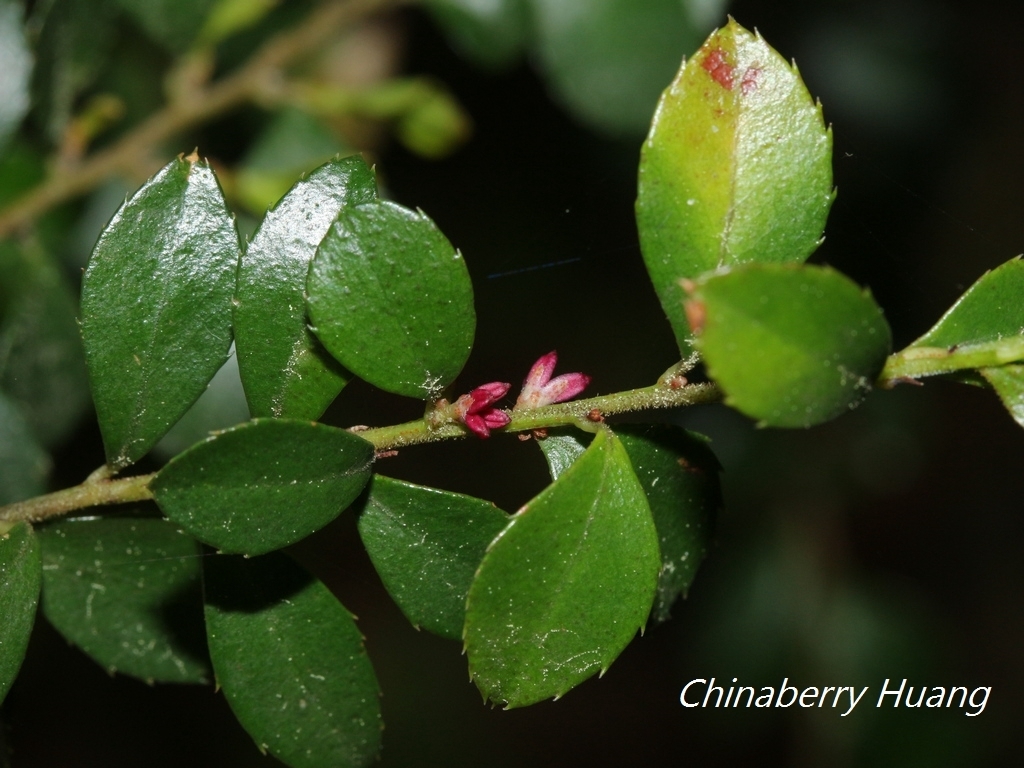 © (c) Lijin Huang (紫楝), some rights reserved (CC BY-NC), uploaded by Lijin Huang (紫楝) (CC-BY-NC)
Description - from Wikipedia
Myrsine africana, also called Cape myrtle, African boxwood or thakisa, is a species of shrub in the family Primulaceae. It is indigenous to Southern and Eastern Africa, the Azores, the Arabian Peninsula, South Asia and East Asia.
Description
The shrub can achieve heights of over 2 metres (6.6 ft) and may be dense if pruned or grown in strong sunlight. The fine-toothed leaves are at first deep red, but on maturity become glossy and dark green. The cream-coloured flowers appear in spring, with the male flowers boasting red anthers. Separate shrubs produce either male or female flowers, with the female plants also producing small purple berries. The foliage is dense, and dark-green to red in color. The hardy plant is long-lived.
M. africana sends up occasional shoots from its root system that go on to form new plants. It propagates easily from seed.
Uses
Parts of the plant are used in milk and meat-based soups by the Batemi and Masai people of Africa, which is thought to reduce cholesterol levels in tribes that consume large amounts of meat. The flowers are also eaten. A powder derived from the plant's leaves is called katam (كتم), used to dye hair since ancient times.
Cape myrtle is increasingly popular for topiaries and small hedges, as it can so readily be pruned and shaped.
Gallery
References
http://www.plantzafrica.com/plantklm/myrsinafr.htm
External links
Media related to Myrsine africana at Wikimedia Commons
Read more here
Species Characteristics
Wildlife supported
Growth features
Social features
Aspect
Soils
Spatial classification
- Cream
- Pink
Propagation
By Seed
Before planting, beds should be well prepared with compost and should be mulched after planting.
In the winter rainfall areas of the Cape, plants should be planted in the winter to give the young plants the time to establish before the dry summer months.
Myrsine africana is slow growing, but long-lived and certainly worth the patience to give it a place in the garden.