Cabbage Tree
Cussonia spicata
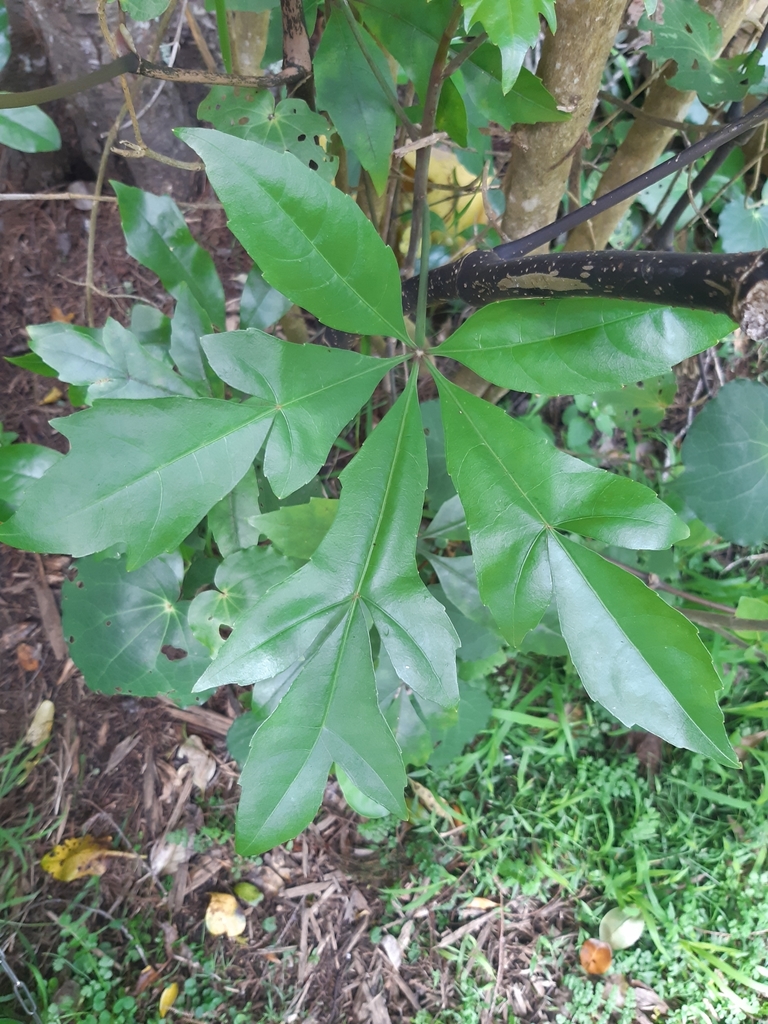 © (c) swatutukaka, some rights reserved (CC BY-NC), uploaded by swatutukaka (CC-BY-NC)
Description - from Wikipedia
Cussonia spicata, commonly known as the spiked cabbage tree or common cabbage tree, is species of tree in the family Araliaceae. Native to East Africa, this species is widely distributed from South Africa in the south to South Sudan in the north.
Distribution and habitat
Cussonia spicata is widely distributed in East Africa, occurring in Botswana, the Democratic Republic of the Congo, Eswatini, Kenya, Malawi, Mozambique, South Africa, South Sudan, Tanzania, Uganda, Zambia, and Zimbabwe, as well as the islands of the Comoros and Mayotte. It grows in both dry and riverine forests, rainforests, wooded grasslands, and savannahs at altitudes of 200–2,550 m (660–8,370 ft) above sea level.
Description
Larger specimens develop a sturdy trunk and a rounded, spreading canopy, and can reach a height of 15 meters. The attractive leaves grow from the end of thick branches to form rounded heads. The species name spicata means "spike-like", and suggests the arrangement of its flowers.
Uses
Cussonia spicata is harvested locally for its wood, roots, and leaves to be used as food, medicine, and timber. The wood is light and perishable but is used to construct beehives, wooden bicycle wheels, doors, mole traps, tool handles, and utensils. The succulent roots are edible and have been used as a traditional malaria treatment. The leaves are harvested for fodder and are used in traditional medicine for treating indigestion. It is used both locally and internationally as an ornamental plant.
In English it is commonly known as the cabbage tree, spiky cabbage tree, common cabbage tree, or elephant's toothbrush. Common names in other languages include:
References
External links
Dressler, S.; Schmidt, M. & Zizka, G. (2014). "Cussonia spicata". African plants – a Photo Guide. Frankfurt/Main: Forschungsinstitut Senckenberg.
Read more here
Species Characteristics
Wildlife supported
Growth features
Social features
Aspect
Plant types
Soils
Spatial classification
- Green