5th Avenue Park Parkhurst
 © Debbie (CC-BY)
Corridor contribution
- To support planting of primarily locally indigenous vegetation (note: we don't expect the garden to currently be there, but the caretaker is willing to work toward this goal).
- To work on removing alien and invasive species.
- To periodically provide updates on the status of the garden.
- When possible, to share seeds or cuttings from the garden's indigenous plants with other members of our network.
This is garden #009 in our corridor.
Description
5th Avenue Park, Parkhurst is a well-used park and well-established park that shares boundaries with Craighall/Craigtowne, Delta Park and Parkhurst. The Braamfontein Spruit flows along the side of the park, with a little tributary that joins up to Hamilton Park, in 21st Street Parkhurst. The park is maintained by the various Residents Associations through regular clean-ups, storytelling and working around and supporting the JCPZ maintenance schedule. PRABOA (Parkhurst Residents Association) engages Jozi Trials and Bubele Africa to help us maintain the park when needed and funds permit. SafeParks 24/7 helps keep us safe. 5th Avenue Park comprises of multiple trees, such as
• Mulberry
• Privet
• Eucalyptus (which houses Owls)
• White Stinkwood
• Wild Olives.
• Rhus Trees
• Peach Tree
- Podcarpus (Yellowood)
Within 5th Avenue Park, volunteers have identified three areas for intervention, these areas have been named:
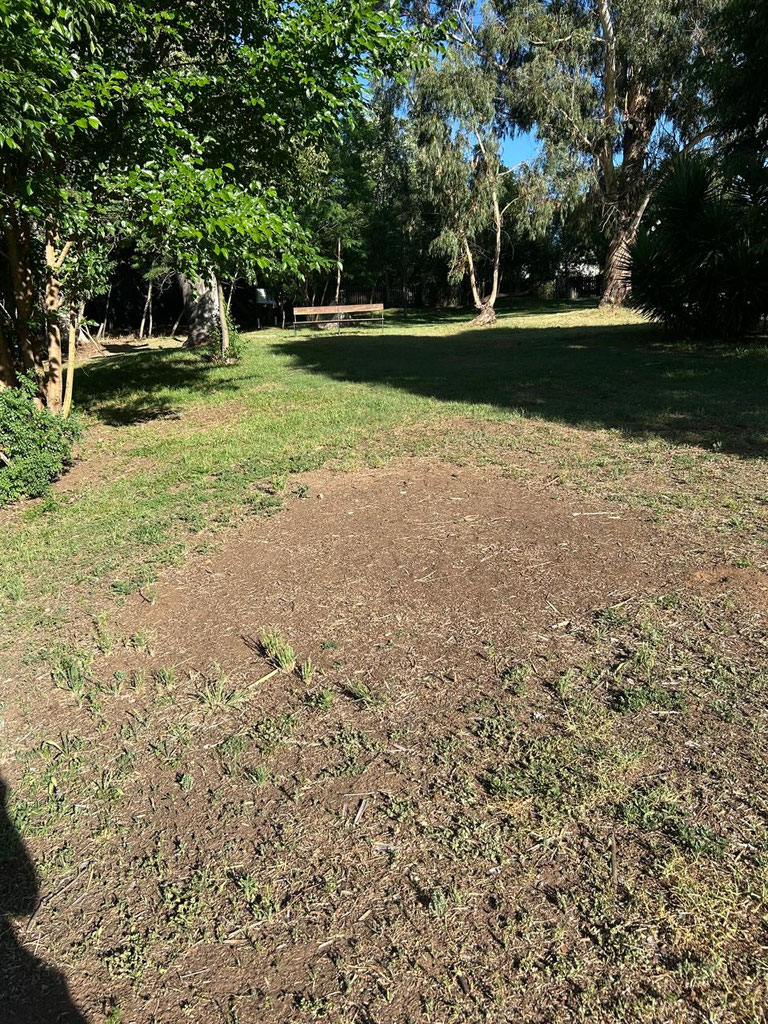
1. Aloe Garden: which is along the smaller tributary in the main park. This would help us revive a bare patch soil in full sun and provide food for pollinators in winter.
2. The Lily Garden is next to the green bridge, alongside the large dead Eucalyptus Tree.
3 The Fairy Garden can be found where the bamboo used to be, and it is in dense shade amongst a glade of trees, and nearer the cul-de-sac boundary.
Erosion and bare soil is a challenge, as well as the water run off from the street into the park and how it runs down into the smaller tributary, we hope that through this project we able to manage this, and prevent further erosion, as well rehabilitate the area with the bamboo and replace a Yucca in the middle of the park. Currently the park is covered in white clover which we purposely leave for bees, and Kikuyu grass. There are other species of grass growing along the edge of the river.
Registered current species
| Species | Common name |
|---|---|
| Buddleja saligna | False Olive |
| Celtis africana | White Stinkwood |
| Olea europaea africana | African Wild Olive |