Carbon Report
An estimate of the sequestration potential for 132A buckingham.
kg of CO₂ per year
Combined tree & soil estimate
Kilometers driven every year
Average petrol car at 0.16272 kg CO₂e per km
Establishing and improving an indigenous garden benefits not only native animals and plants, but it will also contribute positively to the climate. This report estimates your garden's annual sequestration potential based on its specific size and tree count. Read more below on our methodology, how to maximise your impact, and why well-functioning indigenous grasslands can be a great source of sequestering CO₂.
Maximising Your Impact
Compost Locally: Composting green waste and kitchen waste, instead of relying on synthetic fertilisers. This diverts organic waste from landfill where it releases methane and greenhouse gases. Organic compost also contributes nutrients to the soil.
Low-Power Maintenance: Reduce the frequency of mowing lawns and using other powered tools like trimmers, leaf blowers, and vacuums. This helps to reduce energy / fuel usage associated with tools like lawn mowers and trimmers. Approximately 2.2 kg of CO₂ are emitted per litre of petrol combusted. If a small petrol lawn mower uses 0.5 litres of petrol for 30 minutes, that would equate to 1.1 kg CO₂e being emitted into the atmosphere. Equivalent to driving several km in a car.
Water Wisely: Pumping water through irrigation systems also carries a carbon footprint. Rather use low / no energy irrigation systems like rainwater harvesting, or mulching.
Expand Your Garden: Carbon sequestering depends on the number of growing trees, and the total size of your garden (for soil carbon capture). A great way to increase your impact is by increasing your garden size in place of paving, concrete and tar!
Methodology
Our calculations are based primarily on peer-reviewed South African research. We combine tree-specific growth data with soil organic carbon (SOC) metrics from the Highveld. Below we describe how the sequestration factors were calculated. You can also download the spreadsheet with the calculations and a more detailed overview of the research publications that were considered.
TREES
The average carbon sequestration figures for trees were derived from the sources listed below. These sources provide local data that can be used to calculate estimates for average carbon sequestration of a single tree per year.
Carbon sequestration estimates of indigenous street trees in the City of Tshwane, South Africa
sciencedirect.comTo calculate the carbon sequestration potential, the growth rates of Combretum erythrophyllum, Searsia lancea and Searsia pendulina were determined. The results from growth regression relationships were used in a generic allometric biomass regression to calculate the carbon sequestration rate of each species, which was extrapolated to determine the total quantity of carbon to be sequestrated by the street trees over a 30-year period (2002–2032). It is estimated that the tree planting will result in 200,492 tonnes CO₂ equivalent reduction and that 54,630 tonnes carbon will be sequestrated.
The potential of Vachellia kosiensis (Acacia kosiensis) as a dryland forestry species in terms of its water use, growth rates and resultant water-use efficiency
nisc.co.zaIn this study, the water use, growth rates and resultant water-use efficiency of Vachellia kosiensis (Acacia kosiensis) (dune sweet thorn) were quantified within a mature stand of these trees situated on rehabilitated dune mining land in the Richards Bay area of South Africa. The growth rates of individual Acacia kosiensis yielded a mean annual increment of 7.2 t/ha/year. The growth rate / biomass increment per year, was used to determine the carbon content per year.
Is carbon sequestration a viable option for reducing carbon tax?
deloitte.comThis article by Deloitte provides a summary of an academic study analysing the carbon storage potential of Johannesburg in conjunction with similar studies. Based on these studies, the article suggests that on average around 1 800 trees are found in high tree density urban area sample sites (1km² quadrants) across Johannesburg, which equates to around 1 500 tonnes of CO₂ (tCO₂) per square kilometre. Areas with low tree density had an average of 900 trees in sampled sites which equates to around 50 tCO₂ per square kilometre. Research indicates that the average carbon sequestration rates of common South African trees can vary from 0.001 tCO₂ per year per tree to 0.07 tCO₂ per year per tree.
GRASSES
The average carbon sequestration figures for grasses were derived from the sources listed below. These sources provide local data that can be used to calculate estimates for average carbon sequestration.
Lignin dynamics in secondary pasture soils of the South African Highveld
sciencedirect.comReseeding grasses into degraded cropland and using it as permanent secondary pasture may combat desertification and promote sequestration of soil organic carbon (SOC). Our objective was to assess the contribution of lignin and grass-derived carbon to the rates of SOC accrual upon such land-use change. After establishment of the secondary pastures, between 9.0 and 15.3 t of SOC were sequestered in the 0–20 cm of surface soil. The total SOC was used to calculate the tCO₂/ha/year.
South Africa’s grasslands set a global first for community-led carbon markets
africabusiness.comThe Grassland Restoration and Stewardship in South Africa (GRASS) project sold 266 255 carbon credits (Verified Carbon Units) from 95 364 hectares of South African grasslands managed within a two-year monitoring period. This project carries the Climate, Community & Biodiversity (CCB) label under Verra’s VM0042 methodology. The results of the initial two-year monitoring period were used to estimate the tonnes of carbon dioxide per hectare sequestrated per year.
FAQ
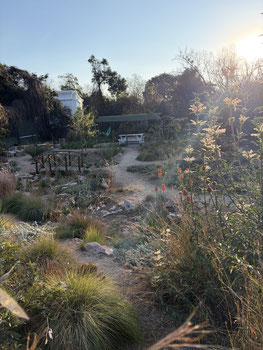
Garden
132A buckingham
Garden size
2,628 m²
Tree count
Annual sequestration estimate
636 kg CO₂